Saturday, April 1, 2023
APRIL FOOL'S DAY
Thursday, March 30, 2023
Tuesday, March 28, 2023
Sunday, March 26, 2023
BEING PREPARED AND.......
Jesus had a large circle of friends, both men and women. On the fifth Sunday of Lent, we get an inside glimpse at three of those friends: Martha, her sister Mary and their brother Lazarus from the little town of Bethany, on the outskirts of Jerusalem. It was that special place in the life of Jesus where he and his disciples could stop in, get some rest, enjoy a good meal and then go on their way! If you pay attention to the details of John’s gospel story about Martha, Mary and Lazarus, you soon realize just how close Jesus was to these people. This is a story about intimate friends, affectionate friends.
First, we know that this Mary was the Mary who kissed Jesus’ feet in public, washing them with her tears, drying them with her hair, and rubbing them with perfumed oil. (When was the last time anybody kissed your feet? You must be pretty close to somebody to do that, not to mention to do it in public!) Read down the text and you see that John underlines, again and again, just how intimate these people were with Jesus. Here’s what it says: “Lord, the one you love is sick.” “Jesus loved Martha and her sister and Lazarus very much.” “See how much he loved him!” They are even so close that one of these women can “chew him out” and get away with it: “Lord, if you had been here, my brother would not have died!” And finally, seeing Mary weep, we are told that Jesus began "to weep,” as well.
One usually thinks of this story as the “raising of Lazarus,” but Jesus’ raising of Lazarus actually occupies a very small part of this story. Of the forty-four verses that constitute this story, only seven of them take place at Lazarus’ tomb. The miracle of the raising of Lazarus is the climax of this story; it is not the center. This is a dialogue between Jesus and the two women about the power of God’s love in their lives.
In his gospel, John’s stories always have two levels: one on the surface which is true and another below the surface which is even truer still. This intimate story is meant to reveal to us not only the depth of their friendship, but also how intimate God’s relationship is with us! The pain of this family is the pain of God for all his people. By listening in to the dialogue, we are also taught what they were taught: the truth about the depth of God’s love for us, about God’s willingness to give us new life, and about God’s power over our worst enemy – death.
(1) We are taught about the depths of God’s love for us. One of the biggest challenges I have faced as a priest is to convince people of God’s unconditional love for them. Why is it that so many of us have been trained by people who have dismissed these intimate stories of God’s love and have combed through the Scriptures, piecing together condemning, judging, and damning messages that they turn into a religion? Why did they, and why do we, find those negative messages more believable? I have received more letters questioning my “too lenient notions of God’s love” than any other critical letters since I became a priest. Jesus revealed the “true God,” not that “false mean god” that people have created since Adam and Eve. Even in that story, God says to Adam and Eve, “Who told you that you were naked?” (Genesis 3:11). In other words, “Who told you that you were bad, separated from me, and defective? I certainly didn’t!” Jesus came to talk us out of that mean God that we keep creating in our own minds. I can’t imagine trying to live my religion without being in love with God! I can’t imagine practicing a religion based on fear and dread!
(2) By listening in on the conversation between Jesus, Martha and Mary, we are taught also about God’s willingness to give us new life. This eternal life is on both sides of death. Death does not have the last word. Eternal life is not just some promise for the future; it is available to us right now. We are in it, as we speak! Through Jesus and in Jesus, those of us who are “dead on our feet” can be resurrected now. We can be “born again.” We can act boldly on our own behalf to live purposeful lives, to help others, and to claim the powers that lie dormant within us. One of my favorite old movies is Harold and Maude. This is Maude’s message to Harold throughout the movie: “Oh, how the world dearly loves a cage! There are a lot of people who enjoy being dead.” Jesus came, not just to bring a wonderful life after we are dead, but one starting right now!
(3) And, as this gospel teaches us, God has power over our worst enemy – death. We live in a death-denying culture. Some of our expensive funeral practices would leave outsiders with the impression that we believe that we are going to come up with a cure for death someday! That makes about as much sense as leaving the runway lights on for Amelia Earhart. We don’t even know how to die. Modern medical technology, as wonderful as it is, robs us of the spiritual experience of “letting go” of this part of our life. Through Jesus and in Jesus, we are able to see in death that “life is changed, not ended.” I feel sorry for those who are conscious at death’s door without this faith.
Over the years, I have had the awesome privilege of talking to some very conscious people getting ready to die: especially those with AIDS and with cancer. Some were not pious people, but most were deeply spiritual. Some were able to tell me that they accepted their approaching deaths and they wanted to “do it well.” Some were extremely thankful for the “eternal life” they had already started to experience in this world. Some looked with “joyful hope” for the “eternal life” ahead of them. You know, if you’re facing death, it doesn’t get any better than that! I hope I can do half as well. I pray for the ability to be conscious, filled with gratitude and ready to go when the time comes! Yes, I want to be conscious! I want to choose to let go and leap into that great unknown, knowing that I will land in the arms of God!
The message to you in today’s gospel is this: God loves you very, very
much. He wants you to enjoy the eternal life that you can start to experience
right now, and he wants you to know that death does not have the last word. You
can enjoy “eternal life” forever, yes starting right now!
Saturday, March 25, 2023
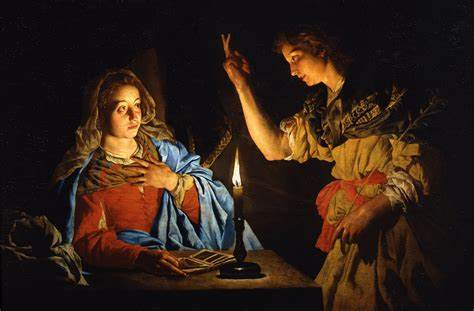
FEAST OF THE ANNUNCIATION
Thursday, March 23, 2023
A MAN WHO COULD CHANGE HIS MIND
Some of us are proud of the fact that we made up our minds about
something years and years ago and that we are not about to change them now. We
may even think that our inflexibility is a virtue. St. Joseph teaches us that,
to follow the will of God, we sometimes have to be able to change our minds.
Again, here's the short version of how St. Joseph was able to
change his mind. Mary and Joseph were engaged to be married. Mary became
pregnant before the wedding and told Joseph that she had conceived through the
power of the Holy Spirit. Joseph refused to believe it at first. He may have
even showered Mary with some harsh words. In response to this unwanted news, he
made up his mind to divorce Mary quietly when an angel appeared to him in a
dream, confirming Mary's explanation and telling him not to be afraid to
proceed with the wedding. Joseph woke up with a changed mind, proceeded with
the wedding and accepted his new family.
St. Joseph teaches us that we sometimes have to “let go and let
God” and find a way to embrace some very painful unwanted realities if we are
to move forward in life. St. Joseph teaches us that letting go in life can be
very hard, but trying to hold onto to an idea we love can sometimes make life
even harder.
( If parents want
their children to grow into healthy adults, they have to “give them up” over
and over again. They have to put them on the school bus that first day, even
though they cry and resist and every bone in their body wants to hold onto them
and keep them home. They have to “let go” when they learn to swim, when
they go off to camp, when they learn gymnastics, when they learn to drive, when
they leave home for college and when they walk down the aisle to begin their
own life. If they “let go,” new life is possible for those children. If they
try to hang on to them and cling to their childhoods, they will retard any
possible growth into self-sufficient adults.
( If someone is
addicted and wants to be free, old patterns and old friendships and old
thinking have to die and be buried before a new way of living is possible. You
cannot hold onto past behaviors and take on new ones at the same time. The old
way of living must die, before a new way of living can be born.
(3 If someone is
in a relationship that is not healthy and life-giving, letting go of it is very
much like a death that one must go through before a new life and a new
beginning and a new relationship can come to life. One must be willing to let
go of familiar territory to reach new lands. The in between time is what scares
people. That’s why abused spouses often return to their abusers: this
in-between time is so scary that they return to what is familiar. By holding on
to the past, they actually kill any possibility of moving into a new way of
living.
(4 Sometimes we have no choice: we are forced into change. Sometimes it takes a heart attack, a terrible loss, an eye-opening accident or a terrible diagnosis, a death of sorts, before we are motivated to bury our old way of living so we can make room for a new way of living.
(5 Sometimes the
church has to go through a great scandal, a purging, a death of sorts, to
really renew itself. We are going through one of those deaths, right now. The
seed of this renewal is in the ground sprouting as we speak. The old
church is dying and a new church is being born. Many find that so scary and
painful that they would attempt to go back to escape the pain of this dying,
but we cannot go back. We must embrace this life-giving process yet again in
our history.
(6 The church has
always grown, not during the times it is most comfortable and respected, but
when we have people being martyred for the faith. There is even an old saying
that “the blood of martyrs is the seed of the church.” The church cannot
be said to be strong until there are enough people who believe it is important
enough to die for.
(7 In my own
personal life, I have noticed that times of greatest life and blessing have
always been preceded by tough times, times of loss and disappointment. It was
when I was forced to let go of some dream, idea, a so-called need or even a
beloved mother, that I witnessed unimaginable breakthroughs. This process has happened so
often that I can sometimes monitor where I am in the process. I even have a
favorite saying: “Breakdown is a sure sign of a breakthrough.”