Sunday, November 12, 2023

WE DON'T KNOW WHEN, BUT WE DO KNOW FOR SURE!


Stay awake, for you know neither the day nor the hour.
Matthew 25:1-13 

Every year or two, I get a letter from the Archdiocesan Priest Personnel Office asking me to update my funeral plans. They want to know, among other things, where my will is, where I want to be buried, what readings I want read, what music I want sung and who I want to preach and preside at my funeral Mass. The last time, I started to fill it out, but finally laid it aside. I just couldn’t get into it. Since not doing it could put both the diocese and my family in a bind someday, they sent a reminder insisting that I fill it out and send it in. I guess I was a little like Woody Allen who once said, “I know everybody dies, but I’m still hoping an exception will be made in my case.”

As we wind down another liturgical year, the church asks us to think about death and entering the kingdom of God. We will be hearing some parables over the next three weekends that will challenge us to make plans for “the end of what we know here” and “the beginning of what we can’t even imagine there,” even though we will still not know the day or the hour.

Today we have the first of three such parables. In today’s parable, Jesus tells a colorful little story about ten invited virgins waiting for a bridegroom to arrive for his wedding. It has some important things to teach us about how to wait for the return of Jesus at the end of time and how to prepare for our attendance at the wedding feast of heaven.

This little story is based very much on everyday reality at that time. Things like this actually happened at weddings back then and they happen even to this day in places in the middle-east. Weddings receptions were nothing like our cake and punch receptions that last a few hours. Wedding receptions back then were week-long blow-outs. To be invited to such an event was a great honor and a good time would have been had by all! Remember the story of the marriage feast at Cana when Jesus turned the water into wine?  The wedding party ran out of wine probably on the fourth or fifth day – and it was at that time, some commentators point out, that the total amount of the new wine created by Jesus would been around 180 gallons. That is the equivalent of about 900 more bottles of wine!

Back then, when a wedding was announced, no precise date or time of day was given, only that it was "about to happen." Couples did not go away for “honeymoons,” they stayed at home and kept an “open house” for a week of partying. Invited guests had to be prepared to join the wedding procession whenever the bridegroom chose to show up for the wedding. It could be anytime, day or night. It could be that day, the next day or in a week or two. Once the groom started toward his house, all the invited guests fell into line and followed him to his house where the ceremony took place. If he decided to begin the wedding procession at night, you had to be prepared because it was illegal to be in the streets without a lighted lamp. Once the bridegroom and his guests came through the streets and entered his house, the door would have been shut and late-comers would not have been admitted.

In this story, five of the ten virgins brought extra oil for their lamps in case the groom were to be delayed, while the other five were not prepared for such an eventuality. In this story, the bridegroom took his time in coming and the five foolishly unprepared virgins were “caught with their pants down,” so to speak. Having run out of oil, they would have had to wait till morning to go for more. In the meantime, the wedding party would have reached the house and the door would have been barred. As a result of their miscalculation, they would have missed out on one hell of a party! The main message for us is simple:  “If you snooze, you lose!”

The first thing this parable teaches us is that the end is going to be wonderful for those who are ready for it. Even though we claim every Sunday in the prayer after the Our Father that we “wait in joyful hope for the coming of our Savior, Jesus Christ,” most of us still believe that the end of our lives will be about sadness and loss, doom and gloom. Not so! Rather, in the end: “Eye has not seen, ear has not heard, nor has it even dawned on us the great things God has in store for those who love him.”

The second thing this parable teaches us is that when it comes to the great “wedding feast of heaven,” living in readiness, waiting in joyful hope, makes a lot more sense than running around and trying to get ready at the last minute, with its risk of missing out altogether.

The more I read these parables, the more I believe that if there is a “hell,” it is the pain of realizing that we have missed out of the greatest opportunity in the universe and it was our own fault!  I don't think of “hell” as a matter of God punishing us or getting even with us for a wasted life, but a matter of us snoozing and losing because we were not paying attention and we were not prepared for the great experience offered us!  

Just as the whole town was invited to first century weddings, we are all invited to the great wedding feast of heaven. It’s up to us if we miss the boat. If we were to put in today’s language, all of us has been given a free, winning Powerball ticket for the zillion dollar drawing and some of us will have misplaced it out of carelessness and inattention. Can you imagine what it would be like to know the rest of your life that you threw away a $100,000,000 lottery ticket because you were careless and weren’t paying attention? Can you imagine missing something, even more wonderful, so wonderful that human beings can’t even begin to imagine it? That “something wonderful” is the “eternal life” that Jesus offers each one of us! 

The third thing this parable tells us, just as others like it, is that we do not know, nor can we predict, the day or the hour. I get so tired of those TV evangelists who claim to be able to de-code the so-called “prophecies” about the “end time.”  Jesus says “do not listen to them and do not follow their prophecies” Jesus is clear: we must live in readiness, not look for signs and portents so that we can predict the end and then “get ready.”  The only reason to try to predict the end, is so we can live anyway we want and then try to get ready right before the final bell rings. Forget it! You can’t predict it. The only thing you can do is live in readiness with your lamps lit, your belt around your waist and with your shoes on, as the scriptures so poetically puts it.  Like a pregnant woman with a bag packed ready for the trip to the hospital, no matter what time of the day the labor pains hit, we Christians are called to live with our bags packed be ready when the time comes!

We all like to think that we will all die after a long illness when we are old, but that may not happen. Most of us would welcome just going to sleep one night and never waking up! Personally, I pray mostly for a pain-free exit. We certainly don’t know when our time here is up! We may die today, tomorrow, next month or years and years from now. We just don’t know, so we must live in readiness so that we will not miss out on the most incredible event known to human kind. Living in readiness does not mean that we are morbidly preoccupied with death, it means to live a full life every day, to be the very best human being we can be, to love God with all our minds, hearts and souls and our neighbors as ourselves. As one of my favorite quotes puts it, “If everyone would sweep in front of his own door, the whole world would be clean!” If we would all live that fully, then it wouldn’t matter when the end would come, because we would already be prepared!

Yes, it might be wise to make your end-of-life plans, but remember that that is not nearly as important as planning to live your life as best you can while you can!  If you do that well, you won’t have to worry about “the end!” 


Saturday, November 11, 2023

A WELCOME MESSAGE FROM MY CLASSMATE, FR. CHUCK DITTMEIER


from the
English Catholic Community
Newsletter
of
Phnom Penh, Cambodia


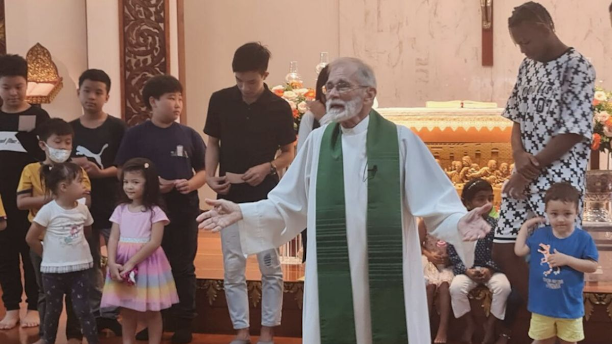
Father Charles Dittmeier, a Louisville priest, has served in various Asian countries for many years, as a parish priest specializing in ministry to deaf communities. At the present, he is serving in Phnom Penh, Cambodia.  The moving announcement below is featured regularly in his newsletters. 

Everyone Is Welcome
• No matter what your personal history, age, background, race, sexual orientation, nationality, etc.,
• No matter what your present status in the Catholic Church,
• No matter what your own self image,
You are invited, welcomed, accepted, loved, and respected here.
 

That's why we call ourselves "catholic" because "catholic" means universal and inclusive! We accept all people, not because they are "catholic," but because we are "catholic."


Thursday, November 9, 2023

A HEART THAT IS "PURE"


GIVEN AT THE LITTLE SISTERS OF THE POOR 11-6-2023

"When you hold a lunch or a dinner, do not invite your friends or your brothers or sisters or your relatives or your wealthy neighbors, in case they may invite you back and you have repayment.”
Luke 14:12-14

One of the Beatitudes that people often misunderstand is this one: “Blessed are the pure of heart.” They often think it has to do with chastity - not having lustful thoughts nor engaging in immoral sexual activities. It really means “doing the right thing while doing it for the right reason.”

As odd as it sounds, one can do a good thing, but do it for the wrong reason and therefore lose any merit it may have generated! Jesus gives us a good example – throwing a lunch or dinner for the very people who will throw one for you. There is no merit in an exchange of “you scratch my back and I’ll scratch yours.” There is no reward in that because you have already been paid back. Jesus teaches us that if you want God to reward you, it is better to throw a lunch or dinner for those who have no way to invite you in return! What Jesus is actually teaching here is that we should be like God himself who gives generously to people who have no way of paying him back.

We all know that being generous to others is a basic tenet of the Christian faith, but what we have here is a challenge to examine our motives for being generous. Being generous for selfish motives not only voids any credit we might get with God, but exposes our generosity as self-serving.

(1) We can give to God and others much in the same way as we pay our income taxes – a grim duty that we cannot escape.

(2) We can give purely from motives of self-interest. When we give so that we will get a building dedicated in our honor, so that we will get a tax deduction, so that we will be honored in the newspaper, we give from a rationalized selfishness.

(3) We can give merely to gratify our own vanity and our own desire for power and admiration. We can give from a need to feel important and be looked up to as superior.

(4) We can give from a pure heart – simply to help another human being. The Rabbis in Jesus’ day had a saying that “the best kind of giving is when the giver does not know to whom he is giving and when the receiver does not know from whom the gift came.”

God gives his gifts to us simply because he loves us, not because he is going to get something in return. As the Common Preface IV says, “You have no need of our praise and our praises add nothing to your greatness, but they profit us for salvation."

What “purity of heart “means is this: if one gives to gain a reward, he will receive no reward; but if one gives with no thought of reward his reward is certain. Like God himself, we are challenged to give out of pure love, not because we will get something out of it.

A pure heart is both a gift and a goal. Pure hearted people are kind and generous with others without ulterior motives. They show their love by practicing selflessness. They simply want others to benefit from the joy of their giving!


Tuesday, November 7, 2023

THE SEPERATION OF CHURCH AND STATE


One of the great things about retirement is that you can finally say what you want to say for the most part without much repercussion.

One of the issues that is building within me is my complaint about the Church's present obsession with aligning itself with political power as a path to accomplishing its goals - a temptation that Jesus firmly rejected when the devil proposed it to him when he was in the desert discerning the direction of his ministry.

A growing number of Roman Catholics are ignoring the Church’s obsessions with sexual morality. Having failed to convince and persuade them, some of our bishops have now turned to the government to force their moral conclusions onto other people. As a result, some American Bishops have fallen into the temptation to partner with those who seek to build an American government that will enforce conservative Catholic and right-wing Christian moral teachings.

To me, they are simply proving their painfully obvious spiritual leadership failures. They seem to believe that if you can't convince people, force them! They have even begun to join those who would destroy democracy (where contradictory moral opinions are allowed) and embrace authoritarianism (where only one moral opinion is allowed). I might agree with most of their moral stands but I totally reject their methods for gaining acceptance of those stands. Jesus rejected potestas (the power of force) and promoted auctoritas (the power of persuasion). “This man speaks with authority, unlike the scribes and Pharisees.”

Having learned little from history, they are again choosing the disastrous path of being a penny wise and a pound foolish. In the process, they are now losing what little moral authority they once had. It's sad and frustrating to watch!


Sunday, November 5, 2023

THE LAITY AND THE CLERGY HAVE COMPLEMENTARY VOCATIONS

National Vocation Awareness Week Begins Today

One of the most amazing statements I have ever read as a priest was not by Pope John XIII or even Pope Francis, but a statement by Pope John Paul II, the champion of neo-conservative Catholics and those who are promoting the return of the old pre-Vatican II "clericalism."

Pope John Paul II was clear and firm in his teaching that in the universal call to holiness of baptism, "Ordained priesthood does not of itself signify a greater degree of holiness with regard to the baptismal priesthood of the laity, but gives to priests a particular gift so that they can help the laity exercise faithfully and fully the baptismal priesthood they have received." In other words, the laity don't serve priests. Priests serve the laity! Diocesan priests are called from the laity, to live with the laity so as to serve the laity. As far as I am concerned, anything else invites "clericalism."

What is clericalism? Clericalism is an exaggeration of the role of the clergy to the detriment of the laity. In a culture of clericalism, clerics are put on a pedestal and the laity are overly deferential and submissive to them. Clericalism is about being put on a pedestal without ever having to earn it simply because one is ordained. (For some, those were the good old days, but certainly not for me!) Happily, I can't remember experiencing more than maybe an hour or two of the laity wanting to worship me on a pedestal! I have always known that many of you are holier than I am and I have always felt that I needed to earn your respect!

Jesus spoke to the crowds and his disciples saying, "The scribes and Pharisees widen their phylacteries and lengthen their tassels. They love places of honor at banquets, seats of honor in synagogues,
greetings in marketplaces, and the salutation 'Rabbi.' As for you, You have but one teacher, and you are all brothers and sisters.
Matthew 23:1-12

When I read those words from today's gospel, I immediately thought of the problem of clericalism in the church. I spent some time on this, so buckle your seatbelts and hold on to your missalettes! I am not going to talk about what's wrong with some of you on that side of the pulpit, as some preachers love to do, but on what's wrong with some of us on this side of the pulpit! To be fair, I need to say that not all, or even most of us religious leaders are corrupt, self-serving and contemptible, but we do need to admit once in a while that it does exists within our ranks. It has always existed, exists now and will probably continue to exist into the future! Clericalism, however, is not restricted to the clergy. It can also apply to some of our lay ministers, as well as ministers in other religions! That's why Pope John Paul II warned against "the clericalization of the laity and a laicization of the clergy." Pope John Paul II insisted that "the relation between priests and faithful is one of complementarity." In other words, the laity assist the clergy in their leadership roles in the church while the clergy assist the laity in their leadership roles in the world.

For a while now, we have been reading the Gospel of Matthew. In this Gospel is where we read about Jesus using his harshest words, not for ordinary people who sinned and failed, but religious leaders who had inherited the chair of Moses but who failed to live up to their calls as trusted teachers. Today, Jesus calls out such religious leaders for their love of honorific titles, religious robes, places of honor and social privilege. In other places, he goes as far as calling them “fakes, phonies and frauds,” and compares them to “beautiful white-washed graves” filled with a rotting stench. He said they might look good parading around in their elaborate religious robes and being addressed by their fancy titles, but underneath they were just using God and his people for their own benefit and glory! I, for one, believe that we need to confront such clerical quackery on one hand, while honoring, encouraging and empowering our competent spiritual leaders on the other!

Today, Jesus warns his followers to separate his message from its messengers. Jesus put it this way. "The scribes and the Pharisees have taken their seat on the chair of Moses. Therefore, do and observe all things whatsoever they tell you, but do not follow their example. For they preach but they do not practice." I remember clearly reading somewhere that: "The validity of the Christian message has never depended on the goodness of its messengers." The great Russian writer, Leo Tolstoy, put it this way, "Condemn me, if you choose, but not the path that I am following." He seemed to be saying that the "path" is still valid, even though I may be a dismal failure at walking it! What a cleric does can still be valid even though the way he does it may be twisted, hurtful and even sinful! 

The real issue with clericalism is not always about a taste for antique vestments, old titles and cassocks, but it's underbelly which is more about privilege, position and power. Clericalism is a culture that can lead to a sense of entitlement, superiority and exclusion. Remember the days when women were not allowed in the sanctuary except to clean it? That was clericalism! Remember when girl servers, women eucharistic ministers and female ushers were forbidden? That was clericalism! Remember when a pastor could publicly humiliate individuals in private and in public without repercussions? That was clericalism! Remember the days when the pastor was always "right?" That was clericalism! Remember the days when respect automatically came with ordination, not something you had to earn? That was clericalism!

All those practices led some clerics to a mindset that “I am better than you, that I am holier than you and that the rules don’t apply to me!” This, in turn, has led to an abuse of privilege and power by some, which tragically includes the sexual abuse of minors as we have all so painfully learned.

In order to overcome clericalism, we need to claim the concepts of "the universal call to holiness" and “the common priesthood of the faithful.” As St. Paul taught us in chapter 12 of First Corinthians, “together we make up the body of Christ, each of us with our particular vocation, each one of us necessary for the healthy working of the body.” We should never equate these distinct roles in the church with levels of worth, dignity or holiness. In other words, we are all priests one way or other - either through Baptism or Holy Orders. Because of our different tasks and roles within the Church, ordained priests do not replace, but promote, the baptismal priesthood of the entire People of God.

The ministerial priesthood, conferred by the sacrament of Holy Orders, and the common priesthood of the faithful, conferred by the sacrament of baptism, are ordered one to another - for each in its own way comes from the one priesthood of Christ. The ministry of ordained priests should therefore always be marked by a fundamental attitude of service to the People of God freed from all presumption or desire of "lording it over" those in their charge. Priests, then, are not "above" the People of God. They are "servants" of the People of God! Anything else is just another version of malignant "clericalism."

The bottom line in all of this is simple. We are all in this together. The clergy are not better than the laity. We are all equals, each serving in different roles. As Pope John Paul II so wisely said, "The more the role of the laity develops. the more strongly the Church needs to have competent holy priests to serve them."

Our role is to help you recognize the varied gifts and charisms in the community and inspire its members to put them to good use for the upbuilding of the mission of the Church in the world. We are effective only when you are effective! Yes, we are definitely all in this together!

In conclusion, I do not want to miss this opportunity to thank all of you for welcoming me as I try to help your pastor in his leadership role in this faith community. Thank you also for your personal encouragement and positive feedback, your faithful service to this community and mostly for just being here each Sunday. As I try each week to inspire you in your discipleship from this pulpit, I want you to know how much you inspire me in my discipleship by your presence. I consider myself blessed to be here! Thank you! Thank you! Thank you!

NOTE 
I need to note that people actually applauded when I finished delivering this homily!